Under the sea where there is little or no light, the foraging, communication, and orientation of whales and many other marine animals depend on sound. But increasing human activity has transformed the soundscape of seas and oceans. This change affects the behaviour of species and presents challenges in managing a problem of global scale.
Many like me feel uneasy when we hear a siren on the street. An ambulance, fire fighters, or the police can remind us of times when we or someone close to us suffered a heart attack, a fire, or a robbery. Animals can also associate sounds with risky situations they have experienced before, such as an attack from a predator, in their own lives or in the evolutionary history of their species.
For example, many types of whales are prey to killer whales (1) [watch predatory scenes here, here, here], and not only do they recognise the presence of their main predator by sound, but the vocalisations of some species have evolved to fall outside the killer whale’s hearing range (2). When faced with such a threatening sound, species must decide whether the risk of being hunted is great enough to justify interrupting essential activities such as feeding or mating (3). Interestingly, there are alarm signals that are so general in the animal kingdom, like a simple noise, that prey animals might react to them by spending time and energy to protect themselves, even when there is no real threat (4).
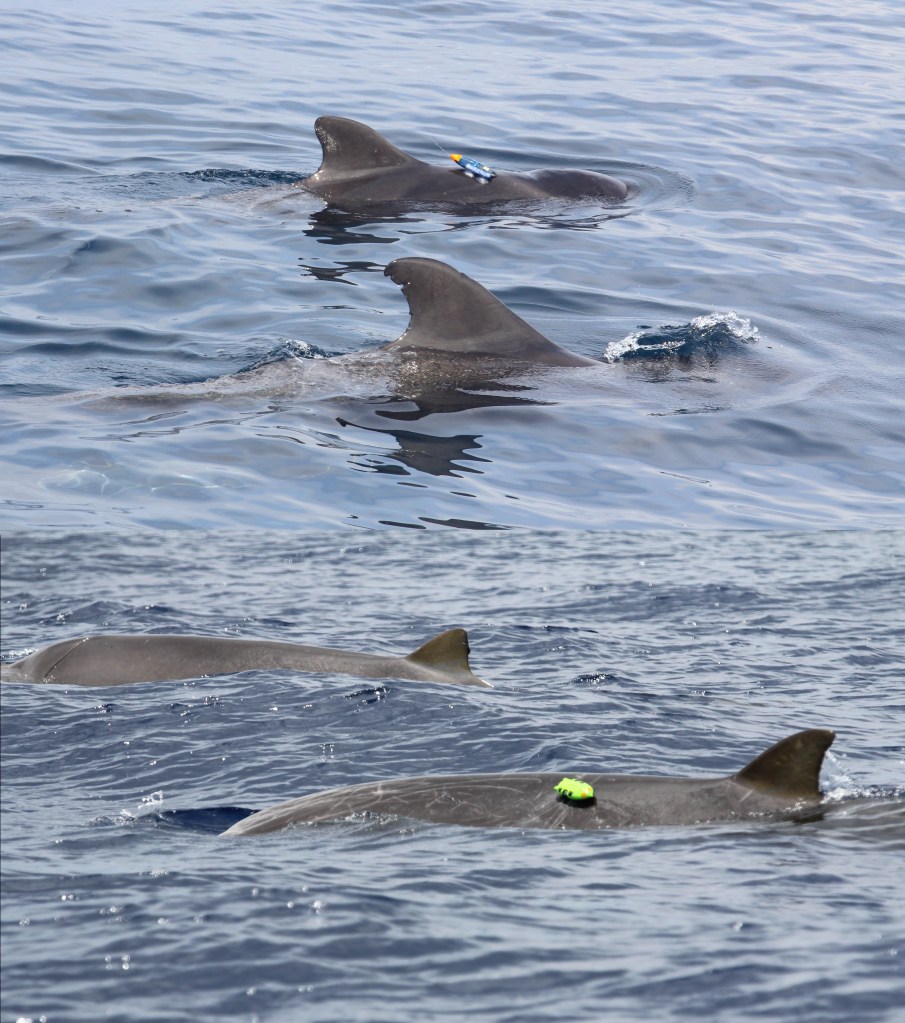
Naval sonar and killer whales
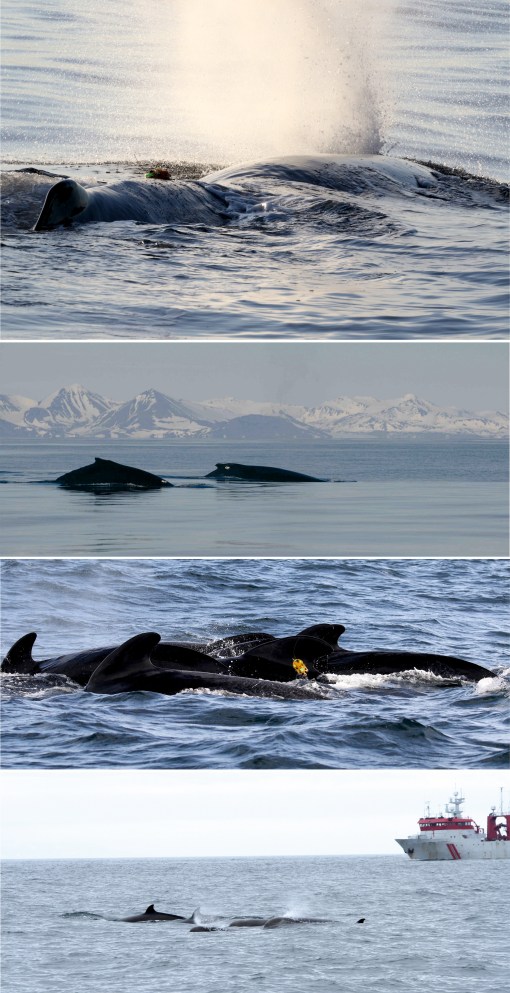
To examine this issue, Patrick Miller and his colleagues used underwater microphones to play recordings of killer whale sounds and ship sonar in the presence of 43 individuals from four cetacean species off the coasts of Norway and its Svalbard Archipelago (5): northern bottlenose whale (Hyperoodon ampullatus), humpback whale (Megaptera novaeangliae), long-finned pilot whale (Globicephala melas), and sperm whale (Physeter macrocephalus) [see press release for this research paper, listen to a podcast discussing findings]. During the experiment, each of the 43 individuals studied was fitted with a digital device attached to the skin using a suction cup. These devices recorded the animals’ movements and vocalisations. In total, the researchers collected 179 hours of baseline behaviour data in natural background noise, along with 7 hours of behavioural data in response to experimental playbacks of sonar [listen] and killer whale [listen] sounds.
Using these data, Miller’s team was able to determine how much time each animal spent feeding and how often they stopped by analysing interruptions in vocalisations and changes in movement (5). In this context, movement and sound serve as biological proxies for cetacean behaviour. Essentially, sperm whales, long-finned pilot whales, and beaked whales do deep foraging dives ranging usually from ~ 200 to some 1,500 metres depth (deepest recorded = 2,288 metres for a northern bottlenose whale (6) off Greenland), with regular echolocation vocalisations to locate primarily cephalopod prey. On the other hand, humpback whales do powerful lunges to engulf schools of fish and sometimes corral the prey using bubble nets produced while ascending vertically from depths of 20–30 metres [watch]. When not feeding, these animals remain at or near the surface, resting, socialiasing, or travelling.
When exposed to experimental playbacks Miller found that both killer whale vocalisations and naval sonar reduced the time dedicated to feeding in all species: 100% reduction in the case of bottlenose whales, ~ 75% for humpback whales and long-finned pilot whales, and 50% for sperm whales (5). In other words, a sperm whale spent only half the amount of time feeding on average compared to what it would have spent had it not heard either killer whale sounds or sonar. And even more extreme, bottlenose whales stopped feeding entirely in response to the threatening sounds. A major finding is that machine-generated sounds can mimic the acoustic signature of cetacean predators, despite posing no real predatory threat.
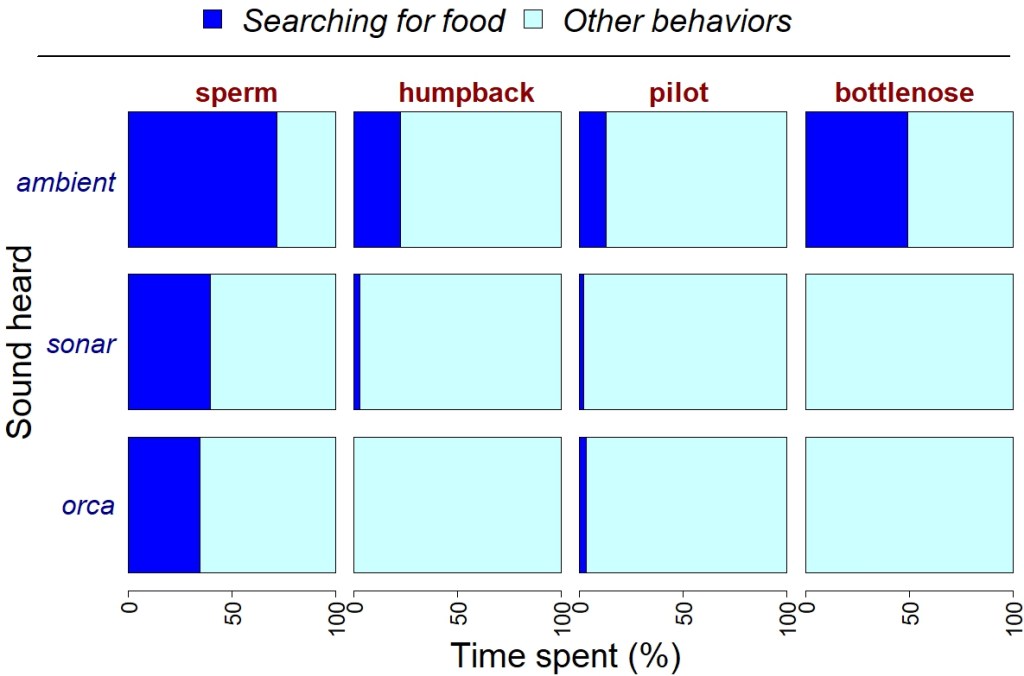
Response to threat
Once characterised only by natural and biological sounds, the acoustic landscape of the oceans in some places is now dominated by noise from human-made machines. This has increased in the three centuries since the Industrial Revolution (7). From ships to offshore wind farms, coastal construction, and oil and gas exploration, many sources now regularly generate local noise. Some of these sounds, such as military sonar, can be associated by marine mammals with the sound of a predator’s call (8). This causes them to enter a state of alert, which disrupts natural behaviour. Species that rely on their large body size or on forming large groups to deter predators (e.g., sperm whales and pilot whales) are affected less by this problem.
The most affected are species that lack social defences and cannot effectively deter a killer whale. This is the case for beaked whales such as the northern bottlenose whale. These medium-sized cetaceans dive to great depths and rely primarily on stealth as their main anti-predator strategy (8). To make it harder for killer whales to detect their location, beaked whales avoid vocalising near the surface and remain silent at depths shallower than ~ 400 m.
This contrasts with the behaviour of pilot whales or sperm whales that often vocalise during their ascent from deep dives to reunite with their social groups, leaving their calves at the surface in the care of other members. In contrast, beaked whales avoid the need to vocalise while ascending because the entire group dives and resurfaces in synchrony. Furthermore, they ascend at a gentle angle rather than vertically. This silent, diagonal ascent reduces the probability of being detected at the surface by killer whales that might be eavesdropping on their echolocation clicks at depth.
Although this unusual behaviour costs beaked whales about 30% of their potential feeding time, it increases their survival probability by > 90% (9). Military sonars used for submarine detection can trigger this kind of behaviour in beaked whales, and the associated physiological stress is thought to have been the cause of mass strandings in many parts of the world (10). For this reason, such sonars have been banned in the Canary Islands since 2004.
The Canarian Case
From 1990 to 2004, several mass strandings of beaked whales in the Canary Islands coincided with naval exercises involving sonar use for submarine detection or live munitions (11, 12). Veterinary studies revealed that the stranded whales exhibited multi-organ hemorrhages caused by fat and gas embolisms (13).
Population studies have identified the Canary Islands as a hotspot for beaked whales, leading to the declaration of a moratorium in 2004 to protect these species from further mortalities. This measure proved effective because no atypical mass strandings of beaked whales have been recorded in the archipelago since (14).
However, two naval exercises have taken place in the past three years near the archipelago, with participation of the Spanish Royal Family in 2023 and 2025 [2023 = Sinkex-23, 2024 = Eagle Eye 24-03, 2025 / Sinkex-25]. These exercises occurred in waters southwest of the islands where whales potentially affected by such activities would likely be transported to the open sea by the prevailing northeast trade winds and the Canary Current flowing in the same direction, precluding their detection if they were to die at sea.
Sound can pollute the sea
Recognising noise as a form of pollution (15-17) is necessary for cetacean conservation because their orientation, communication, and feeding rely on sound signals (18-20). We tend to focus on corrective measures only when they apply to terrestrial ecosystems where noise directly affects humans, but it is in water that sound travels farther and faster.
Unlike other forms of marine pollution such as water acidification, plastics or chemical waste, managing noise is relatively straightforward because it often originates from identifiable sources like ships, oil platforms, or turbines. However, underwater noise has no similar boundaries; it impacts everything from microscopic plankton to large whales, and has consequences for major industries, including fishing and tourism (21).
Every country should monitor noise in its territorial waters, enact legislation to regulate it, (22) and demand international accountability: just as would be done in the case of an oil spill from a sunken tanker affecting multiple states.
The ‘polluter pays‘ principle, widely discussed for global issues like climate change (23), is applicable to all forms of pollution, including noise. Of course, the most effective approach is to prevent pollution altogether — moving from ‘polluter pays’ to ‘polluter does not pollute’ (24). Recent regulations by the International Maritime Organization, which set limits on greenhouse gas emissions [watch here], can reduce speeds across the global shipping fleet (25). This is an important step not only in lowering ship-related noise, but also in reducing the risk of vessel strikes on marine megafauna.
Salvador Herrando-Pérez & Natacha Aguilar de Soto
References
- Jefferson TA, Stacey, PJ & Baird, RW 1991. A review of killer whale interactions with other marine mammals: predation to co-existence. Mammal Review 21: 151-180
- Morisaka T & Connor, RC 2007. Predation by killer whales (Orcinus orca) and the evolution of whistle loss and narrow-band high frequency clicks in odontocetes. Journal of Evolutionary Biology 20: 1439-1458
- Luttbeg B et al. 2020. Safety cues can give prey more valuable information than danger cues. The American Naturalist 195: 636-648
- Frid A & Dill, L 2002. Human-caused disturbance stimuli as a form of predation risk. Conservation Ecology 6: 11
- Miller PJO et al. 2022. Behavioral responses to predatory sounds predict sensitivity of cetaceans to anthropogenic noise within a soundscape of fear. Proceedings of the National Academy of Sciences 119: e2114932119
- Neubarth BK et al. 2025. Long-term depth records of satellite-tagged northern bottlenose whales reveal extraordinary dive capabilities. Ecology and Evolution 15: e71862
- Duarte CM et al. 2021. The soundscape of the Anthropocene ocean. Science 371: eaba4658
- Harris CM et al. 2018. Marine mammals and sonar: dose-response studies, the risk-disturbance hypothesis and the role of exposure context. Journal of Applied Ecology 55: 396-404
- Aguilar de Soto N et al. 2020. Fear of killer whales drives extreme synchrony in deep diving beaked whales. Scientific Reports 10: 13
- Bernaldo de Quirós Y et al. 2019. Advances in research on the impacts of anti-submarine sonar on beaked whales. Proceedings of the Royal Society B 286: 20182533
- Martín V, Servidio, A & García, S 2004. Mass strandings of beaked whales in the Canary Islands. European Cetacean Society Newsletter 42: 33-36
- Simmonds MP & Lopez-Jurado, LF 1991. Whales and the military. Nature 351: 448-448. .
- Fernández A et al. 2005. “Gas and fat embolic syndrome” involving a mass stranding of beaked whales (Family Ziphiidae) exposed to anthropogenic sonar signals. Veterinary Pathology 42: 446-457
- Fernández A, Arbelo, M & Martín, V 2013. No mass strandings since sonar ban. Nature 497: 317-317
- Dominoni DM et al. 2020. Why conservation biology can benefit from sensory ecology. Nature Ecology & Evolution 4: 502-511
- Francis CD & Barber, JR 2013. A framework for understanding noise impacts on wildlife: an urgent conservation priority. Frontiers in Ecology and the Environment 11: 305-313
- McKenna MF, Shannon, G & Fristrup, K 2016. Characterizing anthropogenic noise to improve understanding and management of impacts to wildlife. Endangered Species Research 31: 279-291
- Weilgart LS 2007. The impacts of anthropogenic ocean noise on cetaceans and implications for management. Canadian Journal of Zoology 85: 1091-1116
- Williams R et al. 2020. Chronic ocean noise and cetacean population models. Journal of Cetacean Research and Management 21: 85-94
- Aguilar Soto N et al. 2006. Does intense ship noise disrupt foraging in deep-diving Cuvier’s beaked whales (Ziphius cavirostris). Marine Mammal Science 22: 690-699
- Merchant ND 2019. Underwater noise abatement: economic factors and policy options. Environmental Science & Policy 92: 116-123
- Shannon G et al. 2016. A synthesis of two decades of research documenting the effects of noise on wildlife. Biological Reviews 91: 982-1005
- Stainforth DA 2021. ‘Polluter pays’ policy could speed up emission reductions and removal of atmospheric CO2. Nature 596: 346-347
- Tekayak D 2016. From ‘polluter pays’ to ‘polluter does not pollute’. Geoforum 71: 62-65
- Leaper R 2019. The role of slower vessel speeds in reducing greenhouse gas emissions, underwater noise and collision risk to whales. Frontiers in Marine Science 6: 505
- Aguilar Soto N et al. 2006. Does intense ship noise disrupt foraging in deep-diving Cuvier’s beaked whales (Ziphius cavirostris)? Marine Mammal Science 22: 690-699
- Aguilar Soto N et al. 2008. Cheetahs of the deep sea: deep foraging sprints in short-finned pilot whales off Tenerife (Canary Islands). Journal of Animal Ecology 77: 936-947
- Aguilar de Soto N et al. 2012. No shallow talk: cryptic strategy in the vocal communication of Blainville’s beaked whales. Marine Mammal Science 28: E75-E92
- Aguilar de Soto N et al. (2016). From physiology to policy: a review of physiological noise effects on marine fauna with implications for mitigation. Proceedings of Meetings on Acoustics 27






Leave a Reply